


These ten steps are the action plan I wish I had followed. They came from looking back at every mistake I made and at those moments when I said “pwede na” instead of pausing to verify.
I’m not going to sugarcoat it: some of these steps take time and discipline. That’s why we sometimes opt for “bahala na,” or tell ourselves “nakakatamad naman mag-document.” But building a house is one of our biggest investments, so we must always choose to take action.
1. Write down your answers
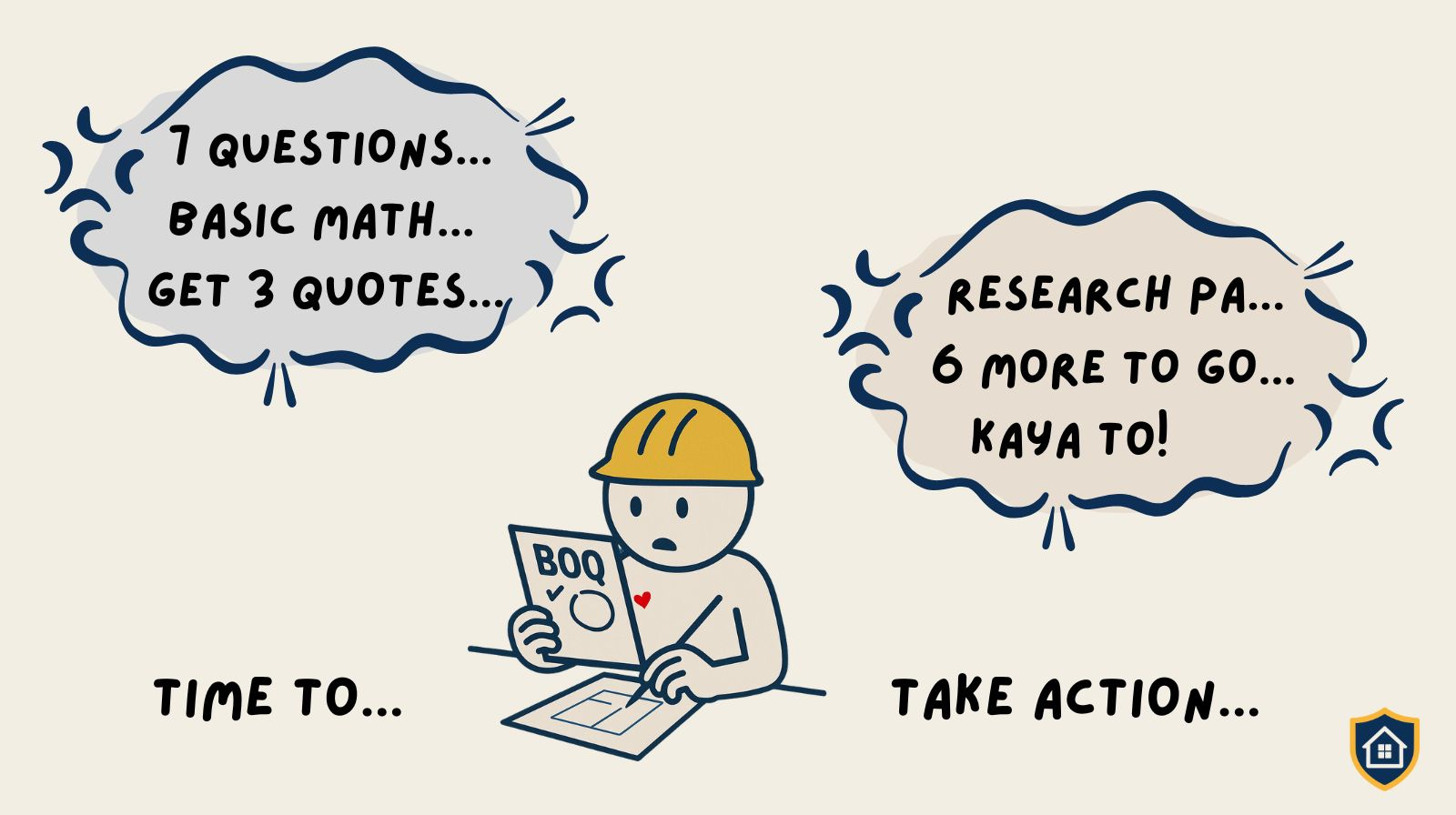
If you haven't taken the Pre-Construction Self-Assessment yet, start there and answer all seven questions honestly. It will also show how ready you are.
Take a notebook or download the PDF copy. Write as if no one’s reading—include your fears, expectations, and pressures. Be honest about the difference between what you actually need and what you want to show off.
Whether you scored mostly “Ready” on the Self-Assessment or mostly “Not Ready,” the following steps apply to you. If you’re ready, they’ll keep you protected. If you’re not, they’ll show you what to work on.
2. Set up your documentation system now
Digital or physical, with backup copies whenever possible. The first document you save? Your answers to all seven questions.
Create folders for everything: savings tracker, fund sources, loan requirements, research, quotes, contracts. When construction starts, add folders for receipts, photos, and messages. If you’re managing from abroad, require weekly photo and video updates and save them all.
No documentation = no payment.
3. Build your safety buffer into the budget from day one
Whatever total amount you have, don’t plan to spend all of it. Set aside 20% as your emergency buffer before you start.
If you have ₱1 million saved, your construction budget is ₱800,000 maximum. The remaining ₱200,000 stays untouched for unexpected costs.
Why? Because “unexpected” expenses aren’t unexpected—they’re guaranteed. Materials go up. You find structural issues. Someone measured wrong. Weather delays mean longer labor costs.
If you’re planning to spend every last peso, you’re setting yourself up to panic when problems arise. And that’s when you make desperate decisions.
4. Learn basic construction math
You don’t need any math-related degree here. Just know how to measure square meters and multiply. Get a tape measure. Measure your current space. Understand what 60 square meters actually looks like versus 85 square meters.
Learn the basic units: cubic meters versus square meters, bags versus individual pieces, or liters versus gallons. Understand when measurements refer to volume compared to area.
Scammers take advantage of you not knowing the difference. I remember a friend told me when I shared my story, “Ah, yun pala gamit ng lahat ng math na natutunan natin sa elementary hanggang college.” She’s absolutely right.
Floor area is one of the first numbers scammers manipulate because it multiplies across every line in your BOQ. I explained exactly how our engineer did this in Floor Area Fraud: How to Spot and Verify “Phantom” Square Meters.
If you want to practice verifying floor area on your own, the Floor Area Verification Checklist gives you the step-by-step process.
5. Research material prices yourself
Before anyone gives you a BOQ, spend a few hours online checking current prices for cement, steel bars, paint, tiles. Check multiple sources—hardware stores, online sellers, construction supply shops.
You don’t need to know everything, but know enough to spot when something’s wildly inflated.
If you’re too busy: It’s either you find a way to get this done or ask someone to do it for you. Price research is your first line of defense, so prioritize it.
Builders add markup to material prices, and that's normal. The problem is when they hide it or inflate it beyond what's reasonable. I broke down how markup works and what to watch for in Philippine Construction Markup Rates: What is a Fair Contractor Fee?
6. Get three quotes, minimum
Never accept the first estimate. Get at least three from different contractors or engineers. Compare them line by line. If one is significantly higher or lower, ask why.
Big differences mean someone’s lying.
Don’t rely on the kakilala system. Look at results like portfolios, finished projects you can visit, or online photos you can double-check. If they rush you or dismiss your questions, walk away.
Not sure where to start looking for professionals? I covered different ways to secure your blueprint and hire the right people based on your actual situation, whether you're on a tight budget, mid-build, or managing from abroad, in How to Get a Blueprint in the Philippines: Costs, Scenarios, and Red Flags.
7. Practice saying “Let me verify that first”
Say it out loud right now. Get comfortable with this phrase: “Let me verify that first.”
You’ll need it when the contractor says materials suddenly cost more or when the engineer assures you, “Don’t worry, I’m transparent, here’s the BOQ.”
Just say, “Let me verify that first.”
And when you have questions, ask them, drop the “hiya.” So what if your questions sound basic or you think you look clueless? Their job is to explain. Your job is to understand and verify.
That “hiya” factor is exactly what scammers are counting on. They thrive when you hesitate to ask. So keep asking. Keep verifying.
And if the thing you need to verify is a BOQ, start with the basics. BOQ 101 explains what a BOQ is, what each section should contain, and what to check first.
8. Separate the roles—never give one person all the power
I made the mistake of letting the engineer handle everything: planning, oversight, purchasing, labor, and even receiving payments directly. That’s too much control with zero checks.
Better approaches:
Option 1: Engineer supervises + Contractor does labor + You control purchasing
Hire an engineer to create the BOQ and supervise. Hire a contractor to handle labor. You (or a trusted person) purchase all materials directly based on the engineer’s list. The engineer and contractor never control the money.
Option 2: Contractor does everything + Separate engineer inspects
Hire a contractor who handles labor and materials. Pay a separate, unrelated engineer to conduct regular inspections and verify the BOQ. The contractor and inspector check each other.
Option 3: You manage everything with the engineer’s guidance
Hire an engineer for the BOQ and periodic site visits only. You hire laborers directly, purchase materials yourself, and manage the project day-to-day. Only realistic if you’re physically present and have time.
The goal isn’t just verification. It’s the separation of powers. When one person controls everything, scamming becomes easy. When roles are split, everyone’s accountable to someone else.
For maximum protection: If you can’t be on-site (like OFWs), add a dedicated verification person on top of whichever option you choose. Give them a checklist of what to verify and when to call you. They report only to you, check the work independently, and confirm what the engineer or contractor says is accurate.
This should be a paid responsibility, not a favor. Yes, it costs extra, but it will protect you from much bigger losses.
Critical: This verification person should not be related in any way to the engineer, contractor, or anyone you’ve assigned to be in charge.
Before you can separate roles, you need to know how to find the right people for each one. The How to Get a Blueprint covers how to hire professionals based on your budget and situation. The Hiring Professionals Checklist can help you vet candidates before signing anything.
9. Write your “something went wrong” plan
Right now, before emotions get involved, create your three-level defense system:
Level 1: When do I pause payments?
No regular updates, suspicious additional costs, not following specifications, no consultation on changes, missing materials, delayed work, too many excuses. Stop paying until issues are resolved.
Level 2: When do I walk away completely?
Wrong measurements in the BOQ, inflated costs you can verify, repeated lies, no professionalism, zero transparency. Cut your losses and find someone else.
Level 3: What’s my maximum loss?
Decide this now in concrete terms:
Amount: “₱50K maximum” or “10% of my total budget”
Time: “Two months of delays” or “three missed deadlines”
Stage: “Any major fraud before 30% completion = full stop”
Scenario: “One inflated BOQ discovered = maximum ₱100K to fix and finish elsewhere”
Have this ready before you need it. When you’re already invested, emotions will tell you to keep going. This plan reminds you when to stop.
10. Find your community
Join homeowner groups. Ask questions. Learn from others’ mistakes and from those who’ve survived scammers. Comment on posts or join discussion threads.
Construction is not rocket science, but it does require homework. Be your own Construction Pulis. We can do this, Kapwa Homeowners! ❤️
Disclaimer: Kapwa Homeowner is not a licensed engineer, architect, or construction professional. The information shared on Construction Pulis is for educational purposes only and should not replace professional advice. Every construction project is unique, so always consult licensed professionals for your specific situation.