

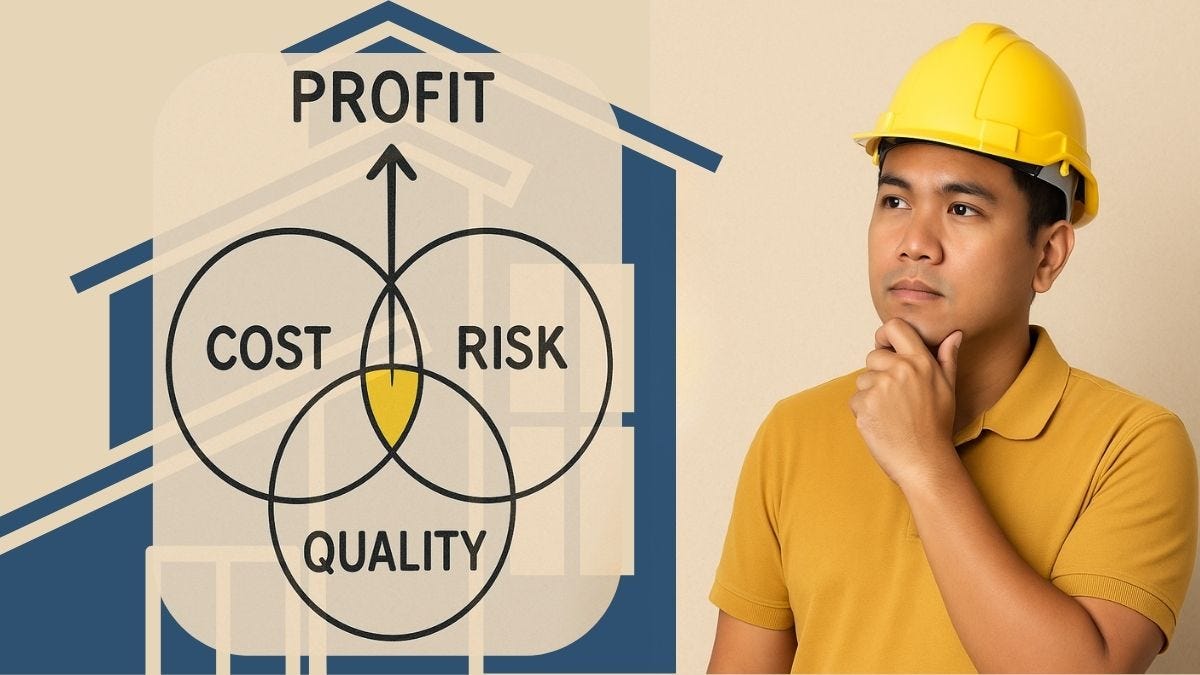
When I got the engineer’s BOQ, I assumed the markup was already included because the total was expensive enough. Huge mistake. I should’ve asked up front, but he never brought it up either.
We didn’t talk about markup until after I caught the fraud. He admitted to the BOQ inflation but insisted all the money went to the first floor anyway. Then he gave me an ‘adjusted’ BOQ and said, “No markups because we’re friends.”
His “no markups” claim meant he worked for free. Right. His explanations kept contradicting themselves until the whole thing fell apart. His supervision fee? Also questionable, but that’s a topic for another day.
We need to understand what markup actually is and what percentages belong in a BOQ. If that information is missing (like in mine), we have the right to ask for it.
In this Dispatch, we’ll cover the universal principles behind markup. That way, when builders throw construction jargon at you to hide or confuse things, you’ll know what they’re talking about and how to respond.
If there’s no transparency, that’s your first red flag to pause and learn about markups. Ready to break it down?
In This Dispatch:
How Markup Actually Works
Before we talk about Philippine construction, let’s cover the basics of how any business sets prices to earn a profit and cover its costs. These principles apply everywhere.
The Universal Pricing Formula

Direct Cost = materials + labor
Overhead = admin, coordination, tools, transport, supervision, time
Profit = income for the business owner
What’s the markup in this formula? Overhead + Profit
So, when you buy a new phone, you’re paying for the direct cost plus the seller’s markup.
No Universal Percentage Exists
We have a universal pricing formula, but there’s no standard markup percentage for all businesses. It’d be easier if we had one. That would be like “Markup Pulis” flagging overcharging. But that’s not reality.
Why no standard? Different industries have different factors to consider: risk, time, difficulty, competition, overhead. A cellphone shop isn’t the same as a construction project, so their markups won’t be either.
Higher Risk = Higher Markup
The higher the risk, the higher the markup. Lower risk means lower markup.
What’s “risk”? It’s how difficult or uncertain the work is: hard-to-source materials, complex requirements, tight schedules, unpredictable conditions.
Why Does Markup Knowledge Matter?
Since there’s no universal markup percentage, scammers exploit that gap. But when you know the pricing formula and what affects markup (risk, market prices, competition), you can spot when something’s off. This knowledge protects both customers and business owners in any industry.
How Markup Works in Philippine Construction
What’s markup in construction?
Markup is the percentage added on top of the actual cost of materials and labor. It’s how contractors and engineers earn their profit and cover their business expenses.
Understanding Markup in Your BOQ
In the How to Verify BOQ Dispatch, we reviewed the anatomy of a BOQ section. Now let’s add markup to the calculation. I found Engineer Donald from Ingeniero TV on YouTube while researching, and his breakdown of unit cost calculation is exactly what our engineer should’ve given me from the start.
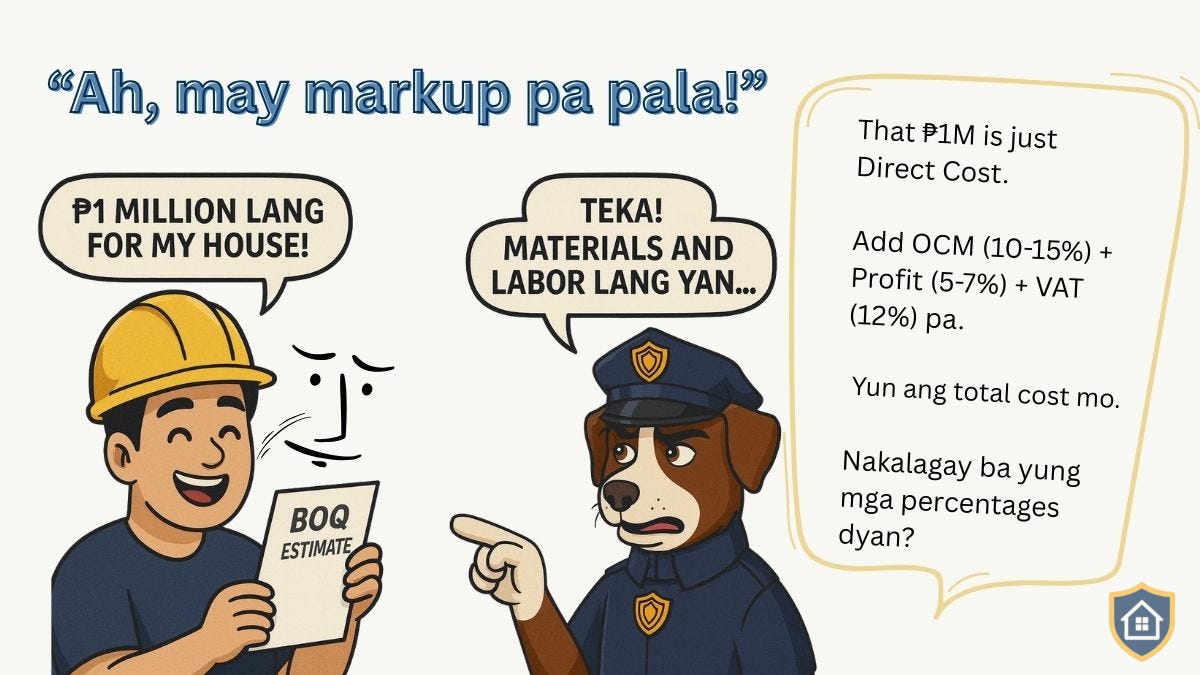
Total Direct Cost (DC) = material and labor costs based on market prices
Overhead, Contingency, & Miscellaneous (OCM) = contractor’s cost to run the project properly, around 10-15%
Profit = what the engineer or contractor earns, typically 5-7%
Value Added Tax (VAT) = 12% of DC + OCM + Profit
Total Cost = DC + OCM + Profit + VAT
Unit Cost = Total cost divided by the scope of work in square meters
Note: Engineer Donald used a masonry section as an example, but this formula applies to your entire BOQ. The markup percentages (OCM + Profit) are calculated on your total direct cost across all sections.
What Does OCM Cover?
Overhead (running the project) - transportation, supervision, tools, PPE, admin time, documentation
Contingency (buffer for surprises) - extra materials, price changes, weather delays, minor errors
Miscellaneous (small essentials) - extension cords, cleaning supplies, worker snacks
So when a contractor says they need to charge for “OCM,” they’re not being vague. They’re covering real costs to manage the project properly.
Markup Simplified
All that construction jargon, in one line:
Markup = Gastos (sa pagpapatakbo ng project) + Kita (sa serbisyong binigay)
What are you paying profit for? Their service in managing your house project—supplying materials, overseeing labor, coordinating everything.
That’s it.
If they start using other terms like “profit margins” or “indirect costs,” just ask: “What’s your total markup percentage?”
As homeowners, though, that’s the next challenge we face: how to know what markup percentage to accept.
The Markup You Should Accept
OCM and Profit aren’t fixed, paiba-iba. They depend on how contractors analyze the project. But Engineer Donald gave us a range to work with: OCM at 10-15% and profit at 5-7%. We can use this as our reference:
15-22% of Direct Cost
Lower end: 10% (OCM) + 5% (Profit) = 15% markup
Higher end: 15% (OCM) + 7% (Profit) = 22% markup
Note: Profit calculation can vary. Engineer Donald computed it as 5% of the direct cost plus 5% of the OCM (which totals around 5-7% depending on the OCM amount). Confirm with your contractor how they calculate profit.
OCM can also be adjusted if contractors want to lower their prices. For example, they can reduce overhead by handling multiple roles themselves: site engineer, purchaser, and quality control. Their OCM then becomes 3% or 5%.
I’ve seen one BOQ that broke it down as: Contingency 3%, Miscellaneous 5%, Overhead 10%. The profit line wasn’t shown separately, but the total was 18%, which is right within the acceptable range. This shows how contractors structure markup differently, with profit sometimes included in the overall percentage rather than listed separately.
Markup Analysis Dilemma
Since markup depends on the contractor’s analysis, that analysis can become subjective, especially if it’s not based on market prices or standard methods.
So you don’t blindly accept the contractor’s analysis, here’s your homework:
Homeowner’s Homework
Develop your own project notes before you even talk to contractors.
Write down everything you know about your project:
“Our house is only 60 sqm.”
“Simple renovation, no complex design.”
“Some materials can be ordered online.”
“Hauling is difficult—house is far from the road.”
“Need to do some demolition first.”
Then ask different contractors for quotes and compare their analyses. When you already know your project’s challenges, their responses either confirm what you identified or give you specific questions to ask.
Once you understand your project, you can assess which markup percentage makes sense.
How to Apply the 15-22% Range
Note: Engineer Donald gave us the range in his video, but he didn’t specify which percentages apply to which project types. So I’m using the risk principle to create an assessment framework. You can use the following as a reference for your project.
15% - Straightforward builds
Standard finishes, minimal customization, nothing unusual. 15% is fair. It keeps an honest contractor in business without overcharging you.
18-20% - Normal complexity
Most houses fall here. Not too simple, not too wild. Standard customization with some personal touches. This is the sweet spot. Fair for both sides.
22% - Upper limit for residential projects
Only justified when your project actually needs it, involves high risk, or you’re hiring an established company with quality guarantees.
It’s like buying a phone. Why are some people willing to pay more for Apple products? Proven quality and design with reliable support. You’re paying for the brand’s track record. Same with hiring an established construction company.
Above 22% - Buwaya Territory
More than 22% is overpricing. 30%? Getting into buwaya territory. 50%? That’s not markup, that’s robbery.
Matching Markup to Your Project
So if you’re building with standard finishes or doing renovations and your contractor gives you a 22% markup, question it. That’s unfair to the homeowner. But if you’re aiming for a high-end, luxury finish, don’t insist on 15%. That’s unfair to the contractor.
Assessment Framework Limitations
This framework gives you a baseline for evaluating quotes. Always get at least 3 quotes with on-site assessments. Their final percentage should be based on your specific project conditions, not just these general guidelines.
Another reference point: Builders often quote ₱25,000-₱40,000 per square meter for turnkey residential projects (ready to move in), depending on finish quality—standard to luxury. This already includes everything: total direct cost, OCM, and profit. You can use this alongside the markup framework to evaluate if quotes make sense.
Paulit-ulit Reminder to Avoid Confusion
15-22% is the TOTAL markup. Always add all the numbers: Overhead + contingency + miscellaneous + profit = total markup.
If a contractor says, “Boss, OCM natin 20%, at yung profit na nga lang namin ay 5%,” do the math—that’s 25% total, already overpricing.
No matter how they label the percentages, and even if profit isn’t shown separately, the total markup percentage must stay within the acceptable range.
The Honest Markup System
Now, let’s review where 15-22% applies.
To the total direct cost, using actual market prices. That means markup is calculated on the actual cost of materials and labor, not on phantom square meters or inflated base prices.
When you meet a builder, check for these five things:
Honest Markup Checklist
1. Separate markup as its own line item - You can see the exact percentage they’re applying.
2. Show base costs that match market prices - When you verify prices yourself, the numbers align.
3. Explain their markup percentage - “Our markup is 18% to cover OCM and profit.”
4. Welcome your questions - They’re not defensive when you ask about pricing.
5. Provide receipts when requested - They can back up their base costs with documentation.
If your builder checks all five, you’ve found someone honest. If they fail even one, ask why. If they fail three or more, walk away.
The Dishonest Markup Tactics
Recognizing honest markup is your first defense. Knowing scammer tactics is your second.
Tactic 1: The Invisible Markup
As Engineer Donald mentioned, contractors calculate markup in different ways. Some apply it to materials and labor separately, others apply one percentage to the combined total (which is what he does). There’s nothing wrong with different calculation methods as long as they’re transparent.
But scammers prefer not to show markup as a separate line item. Why? Because they can inflate base prices above market levels.
I’ll use material costs to show the impact of this tactic. For example, we need 100 bags of cement, and a hardware store sells cement at ₱250 per bag, but your BOQ shows ₱380 per bag.
₱380 × 100 = ₱38,000.00 vs. ₱250/bag × 100 bags = ₱25,000
The difference: ₱38,000 - ₱25,000 = ₱13,000.00.
They’re charging you ₱13,000 extra on cement alone, that’s a hidden markup of 52%. If an honest 15% is applied, you only pay ₱28,750.00 as the final price.
Variation: Inflate quantities instead of prices
Sometimes they use actual market prices but inflate the quantities. For example, cement is correctly priced at ₱250/bag, but they claim you need 150 bags when you actually only need 100.
₱250 × 150 bags = ₱37,500 vs. ₱250 × 100 bags = ₱25,000
The difference: ₱12,500 hidden in phantom quantities.
Why this works for scammers: Homeowners verify prices (easy to check) but don’t verify quantities (requires technical knowledge). Our engineer did exactly this. Some materials had correct prices but inflated quantities.
I’m only showing material costs here. Apply this tactic across your entire BOQ, and you’re looking at massive losses.
Homeowner’s Quick Action: Check base prices online or at local hardware stores. Also, verify quantities. Ask “How did you calculate how many bags/meters/pieces we need?” If they can’t explain clearly, red flag.
I covered how to verify quantities and measurements in How to Verify a Construction Bill of Quantities (BOQ): A Homeowner’s Guide.
Tactic 2: The “Friendship Discount” Markup
This was our engineer’s specialty. There’s no such thing as a “friendship discount.” Not when they say it’s heavily discounted. Not when they claim, “Sa katunayan, kunti na lang kita namin dito.”
No, don’t be fooled by their “sa katunayan…or sa totoo lang…” speech.
Construction is a business. If they claim they’re barely making money, verify their numbers. The markup might be structured differently, or it could be hidden in inflated base prices.
Our engineer’s “friendship discount” was using unbranded materials priced higher than branded ones and pushing labor rates to the maximum, just to mention a few. What a discount!
Homeowner’s Quick Action: Don’t rely on claimed discounts. Pay fair markup (15-22%) with transparent pricing instead.
Tactic 3: The Double Markup
This happens when multiple people touch the same transaction.
Supplier → Contractor → Engineer
Supplier sells cement at ₱250/bag
Contractor buys it and adds 20% markup = ₱300/bag
Engineer bills you and adds another 15% markup = ₱345/bag
You’re paying double markup, but the BOQ only shows the final price. This is why many homeowners opt to buy materials themselves and negotiate labor-only contracts. It’s more work, but you control material costs and only pay markup on labor.
Homeowner’s Quick Action: Ask who’s buying the materials and if any middlemen are involved. If you’re paying double markup, consider buying materials yourself.
Tactic 4: The Percentage Game
You check the BOQ and see a clear 15% total markup with a breakdown showing the OCM and profit. It looks transparent, so you don’t question it.
But that 15% is calculated on already inflated base prices.
This is sneakier than Tactic 1. They show you how transparent they are with their percentages, but they calculate them on already inflated base prices.
Honest calculation:
Actual total direct cost of the whole project: ₱1,000,000 + 15% markup (₱150,000) = ₱1,150,000
Scammer’s calculation:
Inflated “direct cost”: ₱1,250,000 (inflated 25%) + 15% markup on fake cost (₱187,500) = ₱1,437,500
You’re paying ₱287,500 extra. Welcome to Buwaya Territory!
Homeowner’s Quick Action: Don’t just check the markup percentage. Again, verify the base prices it’s calculated on. A fair percentage on inflated prices is fraud.
The Protection is in Transparency
Always demand transparency. It’s your protection.
If there’s nothing to hide, builders will show all numbers and percentages. They’re ready to explain without hesitation and even decline a project if the risk is too high or the budget is too low. Why? They’re also protecting their business.
So, when you find a builder with a fair, transparent BOQ? Pay them well. They’re the ones keeping the industry honest.

Resource Note: Engineer Donald from Ingeniero TV explains unit cost calculation in detail in his video: “TAMANG PAG COMPUTE NG UNIT COST. BAKIT MAHAL MANINGIL SI CONTRACTOR? [ENG SUB]”
Disclaimer: Kapwa Homeowner is not a licensed engineer, architect, or construction professional. The information shared on Construction Pulis is for educational purposes only and should not replace professional advice. Every construction project is unique, so always consult licensed professionals for your specific situation.