

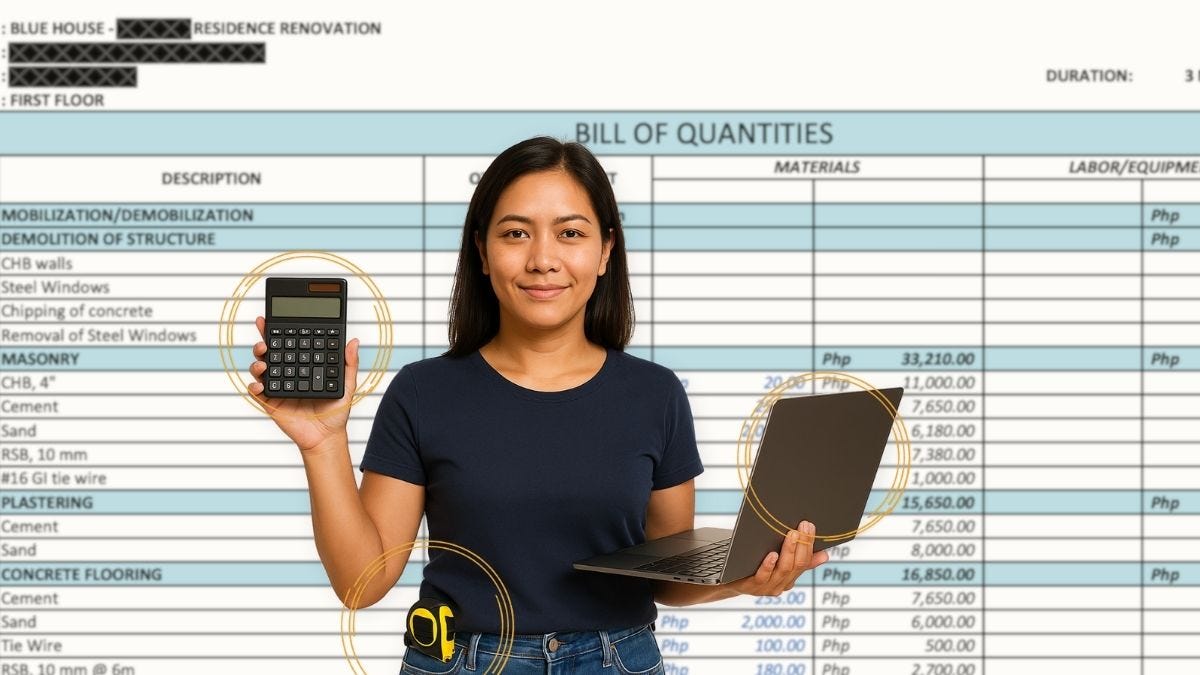
March 2025. The engineer sent me the Bill of Quantities (BOQ) for both our first and second floors.
Pages of numbers that I didn’t really know how to read. It looked professional and detailed. I moved my cursor straight to the part that says total. It was expensive, but the engineer assured me everything was included and blamed inflation for the costs.
His messages, copied as is (March 2025):
“Ate _____ (my name) ito yung estimate nf 1st and 2nd floor.”
“Dahil sa inflation, construction materials tumaas lahat”
“Yung estimate na yan ate. fully furnish na”
“Restruturing kase gawin natin ate para at least maiparent natin sya.”
Relieved and Overwhelmed
I stared at that document, feeling both relieved and overwhelmed. Relieved because finally, after years of construction delays, we had a plan. Overwhelmed because I didn’t expect the price to be that high, and our savings would run short.
I told the engineer we only had 70% of the total amount, with the rest to be remitted monthly. Since the project would take three months, that timing worked. They started construction the first week of April.
If I’d known how to read that BOQ, I would have caught the fraud immediately. The phantom 25.5 square meters were hiding in plain sight. The inflated ceiling measurements were right there on page two. Every red flag was documented, waiting for someone to notice.
I didn’t notice. Not until months later.
In This Dispatch:
What I Should Have Done
Looking back, there were clear steps I should have taken the first time I saw the BOQ.
Trust My Instincts
That shock when I saw the total price should have made me pause and be curious. That reaction was already an instinct to question things.
No Need to Rush
I didn’t have to answer immediately. I had every right to accept or reject it on my own terms and timeline. But what did I do? I immediately said yes without question and came up with a solution to give the other 30%.
Get Other Quotes
I should have contacted at least three other builders while I was in the Philippines, not just relied on kakilala. Accepting that first offer without comparison was a mistake. Multiple quotes reveal who’s overcharging.
Educate Myself
In our Construction Pulis About, I mentioned that construction isn’t rocket science. That’s so true. With the information available online, I should have done my own research.
I got the BOQ in March, and they started in April. Those few weeks should have been my study period. I’d get confused here and there with construction jargon, but it’s not impossible to learn.
Educating myself would mean knowing how to read a BOQ and asking my family to confirm the measurements on-site.
How this Dispatch Helps
Only you can train your instinct and decide your timeline. Getting those quotes is your responsibility, too. As for the education part, learning to read a BOQ and understand what to look for, I hope this Dispatch helps. Let’s start with the basics.
What Exactly Is a BOQ and Who Creates It?
A Bill of Quantities is your blueprint translated into numbers and costs.
Like in masonry, the blueprint shows where the walls go. The BOQ tells you how many blocks you need, how much cement and sand, what the labor costs, and the total price to complete that section.
Your engineer or architect prepares the BOQ, not just your contractor. This should happen before construction starts.
In the Philippines, standard finishes range from ₱15,000 to ₱25,000 per square meter, while higher-end finishes run ₱30,000 to ₱40,000. Those are rough estimates for initial planning. But when you receive the actual BOQ, it’s no longer an estimate. It should be a complete financial breakdown for your entire build.
Full Build vs. Renovation: Different BOQs
My experience is with renovation BOQs, not full builds.
Our Blue Building already had structure. The concrete walls stood. The floors existed. We only needed finishing work: tiles, paint, plumbing fixtures, electrical, ceilings. That’s what my BOQ covered.
A full new-build BOQ is different. It starts from the ground up and covers everything: site preparation, excavation, foundation, structural columns, beams, roofing, the works. Then finishing comes after all that.
A Full New-Build BOQ Typically Includes
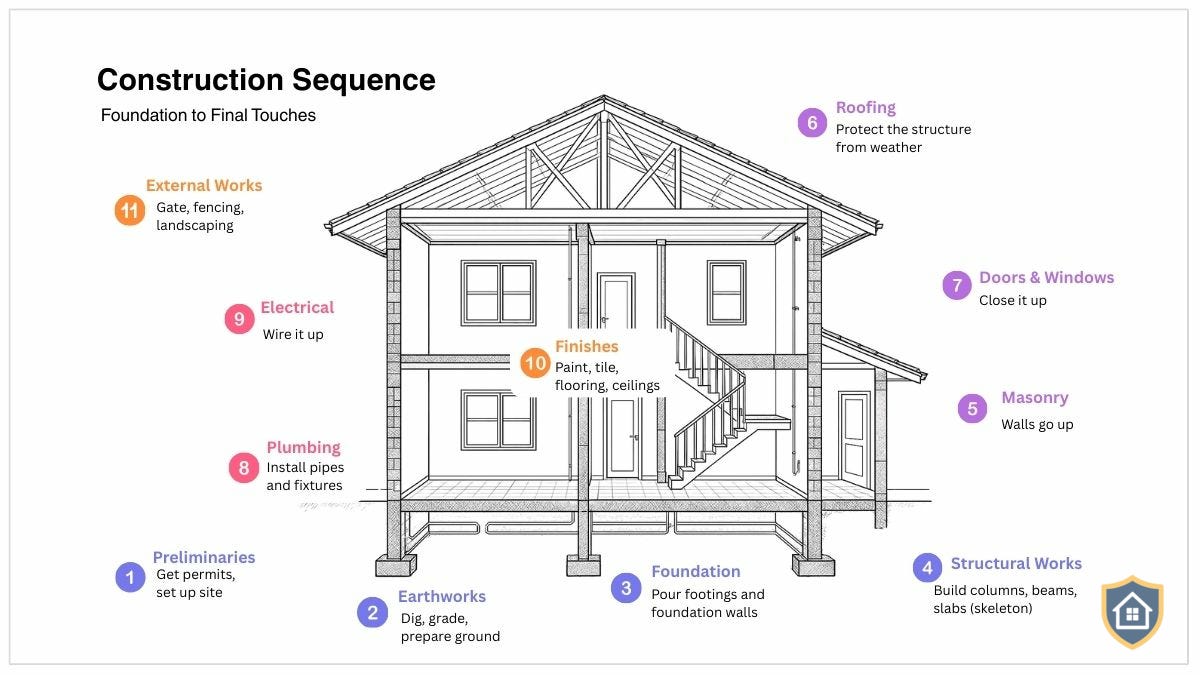
Preliminaries/General Requirements - Permits, site preparation, mobilization, cleanup
Earthworks - Excavation, grading, backfilling
Foundation - Footings, foundation walls, waterproofing
Structural Works - Columns, beams, slabs, steel reinforcement
Masonry - Walls, partitions, blockwork
Roofing - Roof structure, trusses, covering, gutters
Doors and Windows - Frames, installation, hardware
Plumbing - Pipes, fixtures, water system
Electrical - Wiring, outlets, fixtures, panel boards
Finishes - Flooring, tiling, painting, ceilings
External Works - Fencing, gates, landscaping
My Renovation BOQ Covered
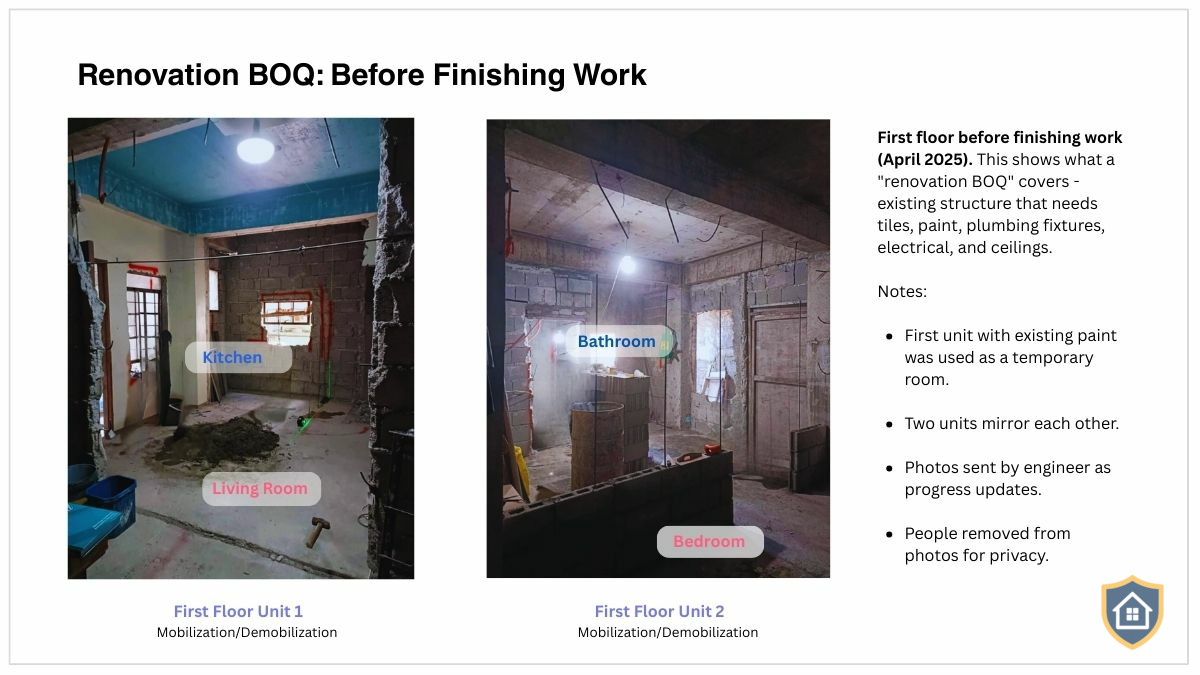
The engineer’s original first-floor BOQ had these sections:
Mobilization/Demobilization
Demolition of structure
Masonry (new partition walls)
Plastering
Concrete flooring (leveling existing floors)
Floor tiles (rooms, kitchen & living room)
Comfort room floor and wall
Painting (exterior wall)
Painting (interior walls and ceiling)
Ceiling
Kitchen area (concreting)
Kitchen wall and top
Windows (supply and install)
Doors
Sanitary pipe
Water piping
Plumbing fixtures
Electrical works
Panel boards and circuit breakers
Lighting fixtures and lamps
Hanging cabinets
Many sections for finishing work alone. Some were lump sum (no breakdown shown), others had detailed material lists.
Since that's what I directly encountered, what I can share here and in the upcoming Dispatches for now is how to verify the finished work.
The Anatomy of a BOQ Section
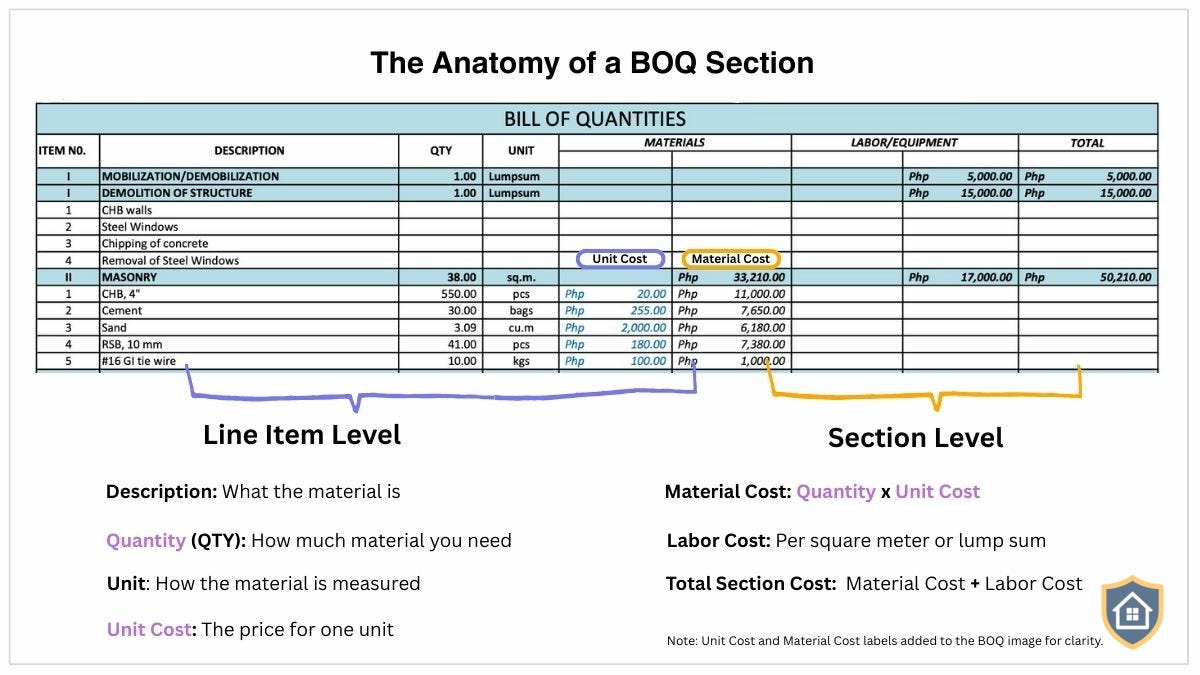
Every BOQ is made up of sections. Each section shows the total materials, labor, and section cost. I’m using the engineer’s actual BOQ structure to explain this—it’s how most Philippine construction BOQs are organized.
BOQ → Sections → Line Items
Section Level: Material Cost + Labor Cost = Total Section Cost
Line Item Level: Individual materials broken down by description, quantity, unit of measurement, unit cost, and material cost.
Understanding both levels helps you spot red flags and know what to verify.
You’ll see me repeat “verify” and “red flag” throughout this Dispatch. That’s intentional. These are the two things that will protect your money.
Line Item Level
Description
What the material is. This should be specific enough that you can search for it online.
Vague: “Ceramic tiles”
Specific: “Ceramic tiles 600 x 600 mm”
The more specific the description, the easier it is to verify the price.
Quantity
How much of that material you need. This number should make sense for the area being built.
Example: If you’re tiling 50 square meters of floor, and each tile covers 0.36 square meters, you’d need about 139 tiles. Add some extra for cuts and breakage, maybe 10-15%, so around 150-160 tiles total.
If the BOQ says 200 tiles for 50 square meters, that’s a red flag.
Unit of Measurement
How the material is measured. Different materials use different units:
Tiles, blocks, fixtures: pieces (pcs)
Cement, adhesive, paint: bags, gallons, liters
Sand, gravel: cubic meters (cu.m)
Steel bars: pieces or kilograms
Bags and pails come in different sizes, so always check. Cement usually comes in 40kg or 50kg bags. Paint typically comes in 16L pails. Without knowing the size, you can’t verify if quantities are correct.
Unit Cost
The price for one unit. This is what one tile or one bag of cement costs.
Verify this number online or in hardware stores. If there’s a big difference between what you find and what the BOQ shows, that’s a red flag.
Section Level
Material Cost
Once you get all the information for your materials from the line item, you can now calculate the material cost.
Simple math: Quantity × Unit Cost = Material Cost
Example: 150 tiles × ₱250 per tile = ₱37,500
That’s the cost for the tiles alone.
Labor Cost
Labor can be calculated per square meter or as a lump sum.
For tiling, using the standard rate: 50 sqm × ₱250/sqm = ₱12,500.
Total Section Cost
Using your material and labor costs, calculate the total section cost.
So the tiling work breaks down as:
- Tiles: ₱37,500
- Labor: ₱12,500
- Total Section Cost: ₱50,000
Each section calculates its own total. The BOQ’s grand total adds up all sections. Use a calculator to verify each calculation. If the math doesn’t match, that’s a red flag.
Once you understand how to read one section, you can read the entire BOQ. Same structure, just repeated across all your materials and labor.
Your Initial BOQ Checklist
Before signing anything, go through this initial check. You probably won’t catch every problem, but you’ll spot the major red flags.
BOQ Completeness
A complete BOQ should list every material, labor, and equipment (if any) needed for every section. Once you receive your BOQ, check each item.
Small adjustments during construction are normal, but if major materials are missing from the start, that’s a setup for surprise charges later.
Don’t just accept the BOQ
Ask directly: “Does this include everything? Are there any materials or work not listed here that we’ll need to pay for separately?” If they promised a complete package or turnkey finish, confirm that’s actually what the BOQ shows.
Floor Area Accuracy
Your floor area measurement should reflect your actual living space, not the building boundary or lot area.
Does the floor area in the BOQ match what you measured yourself? If your floor is 60 square meters and the BOQ says 85, don’t proceed. No need to hear their explanation.
I covered this in detail here: Floor Area Fraud: How to Spot and Verify “Phantom” Square Meters.
Labor Breakdown
Is labor listed as a lump sum with no explanation, or does it show how the cost was calculated?
Even if builders use lump sum, they should be able to explain their calculation when you ask: workers × days, or square meters × rate. If they give vague answers or can’t show their math, that’s a red flag.
Some online resources show how to compute labor rates per square meter for specific tasks. But when labor is listed as a lump sum with no breakdown, verification becomes difficult. This lack of transparency makes it easy to inflate labor costs.
Markup Transparency
Is markup clearly stated and reasonable? Some builders include it in material prices, others list it separately. Both are fine, but it should be transparent. If they won’t give you a straight answer, that’s a red flag.
Markups are how builders make their profit, and that’s fair. What’s not fair is hiding excessive markups in material prices, or claiming “no markup” while still overcharging you.
Want to read more about markup? Philippine Construction Markup Rates: What is a Fair Contractor Fee?
Response Test
Watch how they respond to your questions. If your contractor or engineer gets defensive when you ask about the BOQ, that tells you everything. Honest builders welcome questions because they have nothing to hide.
The “Fully Furnished” Lie
The engineer’s message in March said the BOQ was for a “fully furnished” unit already. He probably meant turnkey finish—complete and ready to move in.
Either way, that means everything is included, right?
But by July, when I started catching his inflated measurements and questioning the BOQ, suddenly the story changed. Before our first video call confrontation, he sent this message. Full palusot mode.
His message, copied as is (July 2025):
“Hindi naman po bloated ate yung BOM. sa katunayan po may mga nailagay po kami na wala sa BOM. Lalo sa electrical and plumbing fixtures. tapus additional sa ceiling. instead na ficem board we opted for pvc panels medyo may kamahalan kunti at least tatagal sya.”
Translation: “The BOQ wasn’t bloated. In fact, we added materials that weren’t in the BOQ. Especially in electrical and plumbing fixtures. Plus additional for the ceiling. Instead of fiber cement board, we opted for PVC panels which are a bit more expensive but at least they last longer.”
(Note: He wrote “BOM” because I’d been typing it that way in my messages. He meant BOQ—Bill of Quantities. BOM refers to Bill of Materials, which only lists materials without labor or equipment.)
What His Message Reveals
The BOQ was incomplete from the start. He’s now saying there were materials “not in the BOQ.” But he told me in March it was fully furnished. Which was it?
He made material substitutions without consultation. Fiber cement board to PVC panels. More expensive. Did he ask me first? No. Did he explain the cost difference? No. He just decided.
He only explained after getting caught. We were three months into construction, and he’d never mentioned these additional materials or cost changes. Only when I confronted him did they suddenly appear.
If I had remained clueless until the end, those “additional materials” and “more expensive” substitutions would have meant paying even more. His “fully furnished” BOQ, now conveniently incomplete, was a setup for extracting additional charges.
But he got caught. So those “additional materials” became his excuse to cover the money trail. He reverse-engineered the BOQ, adding items until the numbers matched my remittances exactly.
The audacity of this engineer is something else. This was just one of many tactics he used. More will be revealed as we go through each section of the BOQ in future Dispatches. For the complete story of how he scammed us from the very beginning, read: How a Trusted Engineer Scammed Us: A Cautionary Construction Story.
You Can Learn This
A BOQ is just organized math. If you can calculate, measure, and search online, you’re a homeowner ready to verify your BOQ.
The power isn’t in understanding every technical detail. The power is in asking: “How did you get this number?”
Honest builders show their math. Dishonest ones get defensive or give vague explanations.
Let’s use that power.

Disclaimer: Kapwa Homeowner is not a licensed engineer, architect, or construction professional. The information shared on Construction Pulis is for educational purposes only and should not replace professional advice. Every construction project is unique, so always consult licensed professionals for your specific situation.