

Kung lolokohin ka ng builder, dito sila magsisimula: sa floor area. Bakit? Kasi pag mali yung square meters, lahat ng materials at labor sa BOQ ay apektado. One inflated number, multiplied across everything.
How They Hide It
They don’t just add random numbers. They use measurements you won’t question because they look “official.”
How did Kapwa Homeowner's engineer hide it?
Building boundary instead of floor area. The engineer measured the full footprint of the first floor (including setbacks and areas outside the walls) and called it the floor area. Different thing entirely!
Extension padding. One bathroom on the second floor has a 0.5-meter extension. The engineer applied that extension to the entire building width. Suddenly, every corner has space that doesn’t exist.
Both tactics hide phantom square meters in measurements.
What Phantom Square Meter Costs
At ₱25,000 per square meter, a 60-square-meter house costs ₱1.5M.
Inflate that to 85 square meters? You’re paying an extra ₱625,000 for nothing. That’s 35% inflation for phantom space.
Even “small” inflation of 5-10% means losses of ₱75,000 to ₱150,000. That’s money that should’ve gone to your actual house.
What to Watch For
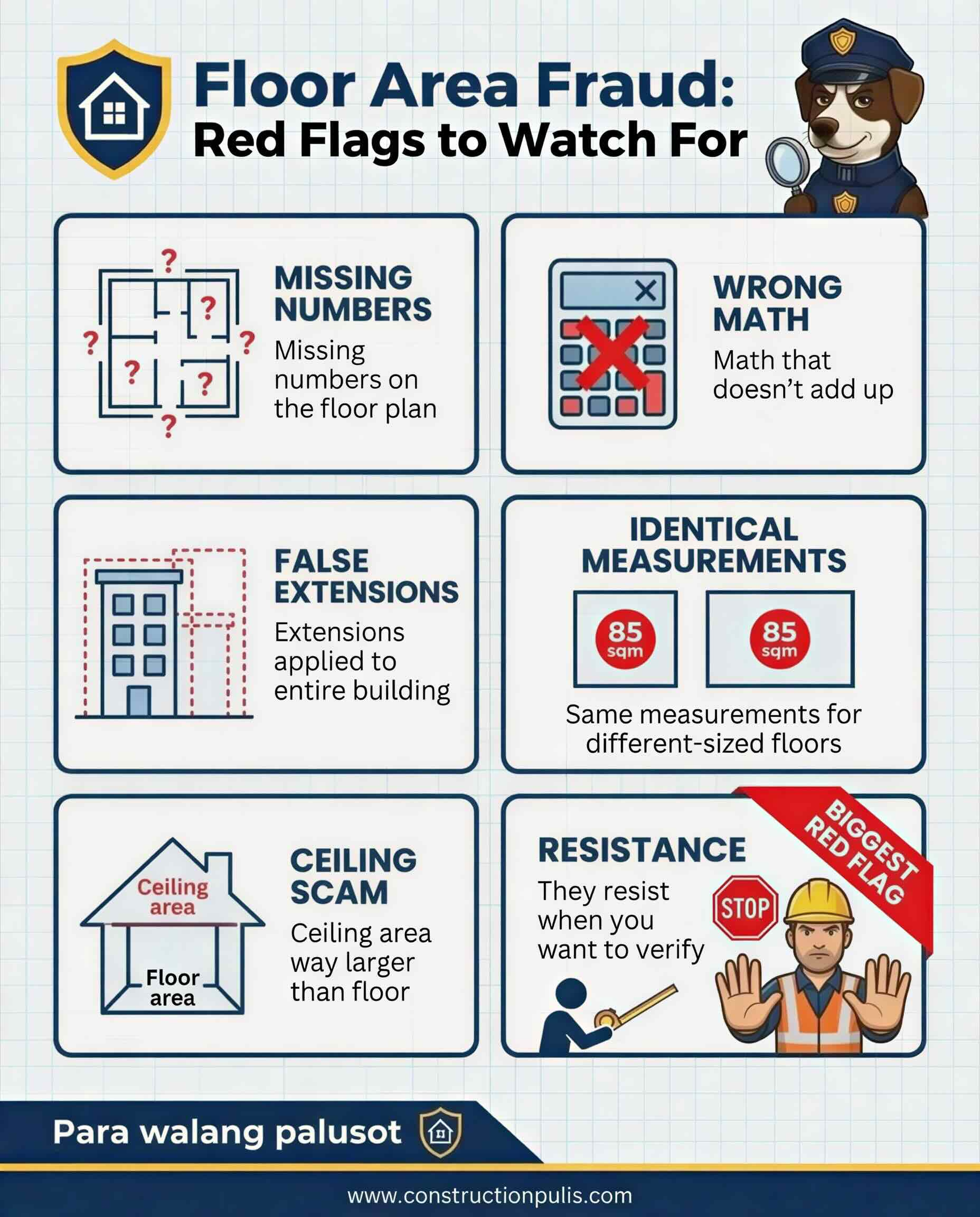
If they say “we add allowances” or “we round up,” that’s palusot. Allowances apply to materials, not measurements. Standard practice is exact measurements, not even 1% added.
What You Do Next
Verify the floor area yourself. Get a tape measure. Measure each room. Calculate the total. Compare it to the BOQ.
If the numbers don’t match, don’t proceed.
Ready to verify? Use the Floor Area Verification Checklist to measure your space yourself.
Want the full story? Read the complete Floor Area Dispatch for tactics and questions to ask.
If the actual space is 60 square meters, it should be 60. No more, no less.
Inspector Milo is Construction Pulis’s vigilant mascot who shows up with warnings and reminders to homeowners. Para walang palusot. 🐾