

Wrong assumptions and ignored steps are how fence disputes start, which are 100% avoidable.
Mistake 1: “It’s my land. I can do whatever I want with it.”
Very wrong mindset.
You cannot build whatever fence you want, as high as you want, without asking anyone. Yes, it’s your land, but you have neighbors and the law to consider.
This is how the Sulit Family thinks, and it’s what gets them in trouble.
Even if the lot next to you is empty, find out who owns it before you build anything. Asking first costs you nothing. Searching online about rules, easements, and setbacks is worth your time.
Mistake 2: “It’s just a fence, I don’t need a permit.”
If your contractor says, “Hindi na kailangan ng permit yan, bakod lang naman,” that’s a red flag. Your contractor either doesn’t know the law or knows it and ignores it.
Building a fence either requires an accessory permit or a full building permit under the NBCP. Read the Fence Dispatch for the specifics.
Applying for that permit also reveals what you need to complete first, so you can start everything right and avoid demolitions or fines later.
Mistake 3: “No need to relocate or verify the mohon.”
“Di naman na siguro kailangang iverify yung mohon. Andyan na yan, eh.”
Skip hiring a geodetic engineer to do their job, and you’re gambling.
Back to the empty lot scenario: you build an expensive concrete fence, a year later, the owner surveys their land, and discovers your fence is 0.2 meters inside their property. What now?
If a Dispute Has Already Started
Barangay conciliation is the required first step, not optional. It’s part of the process. Most civil cases can’t even be filed without it.
If barangay mediation fails, it goes to the Municipal Trial Court. At that point, you’ll need a lawyer, your title, survey documents, and any photos or messages from the contractor or neighbor.
The homeowners who come out with the least damage are the ones who documented everything before construction started. I said “the least damage” because both parties actually pay when things escalate to demandahan. Expensive legal fees and a ruined relationship with someone you’ll see every day.
What Does the Law Say About Fence Disputes?
The Civil Code distinguishes between a builder in good faith (hindi sinasadya) and a builder in bad faith (alam, pero built anyway).
If your neighbor genuinely did not realize their fence crossed your property line, the law treats them differently than if they did it intentionally. Good-faith builders have rights over what they built. Bad-faith builders do not.
Even an honest mistake (good-faith builder) can turn into a court case if not handled properly. Pwedeng mapag-usapan lahat before it escalates.
If you’re the one who crossed the line, take the initiative. Set up the meeting. Be calm, be humble, and be ready to offer solutions or listen to your neighbor’s options.
If it’s your neighbor who crossed the line, hear them out. If they offer to pay for the encroached portion, be fair. Don’t take advantage of the situation.
In a bad-faith builder scenario, though, it depends largely on the wronged party. They have every right to skip the one-on-one and go straight to the barangay, then to the court that gives them three options: ownership of what’s built, demolition, or compulsory sale at its full value. (Civil Code, Articles 449, 450, and 451.)
As homeowners, you don't want to find yourselves as good-faith or bad-faith builders, but as responsible builders who do their homework to avoid disputes in the first place.
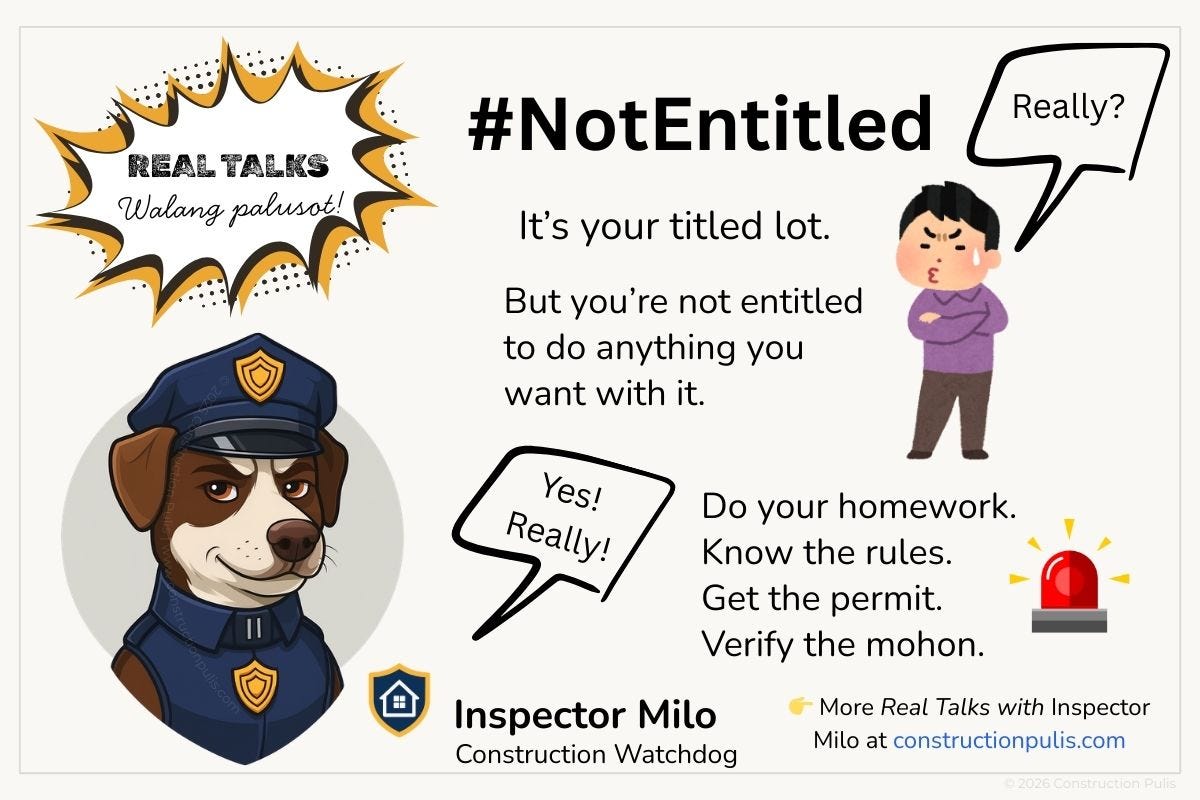
Inspector Milo is Construction Pulis's vigilant watchdog who shows up with the warnings homeowners don't always want to hear. Para walang palusot. 🐾
Resource Note: The rules and definitions regarding good-faith and bad-faith builders are primarily found in the Civil Code of the Philippines (Republic Act No. 386), specifically Articles 448 to 452.