

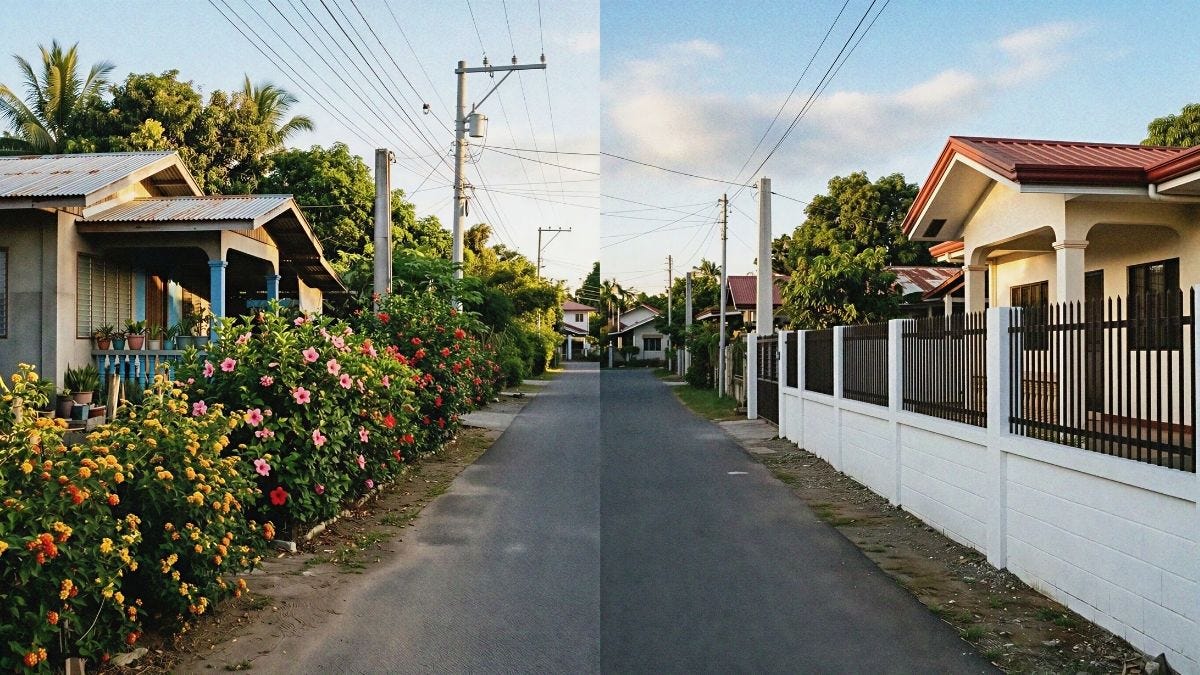
The moment you start building a fence, you’re not just dealing with your property. You’re entering a legal minefield that involves the National Building Code, the Civil Code, your local government, and sometimes your neighbors, whether you like it or not.
This isn’t meant to scare you. It’s meant to help you avoid the kind of dispute that drags on for years just because you didn’t bother to check and assumed it was just a fence.
What the Law Actually Says About Fences
Based on the 2005 Revised IRR of the National Building Code of the Philippines (PD 1096), here are the relevant rules on fences, summarized in plain language. Each rule includes the actual IRR text for reference.
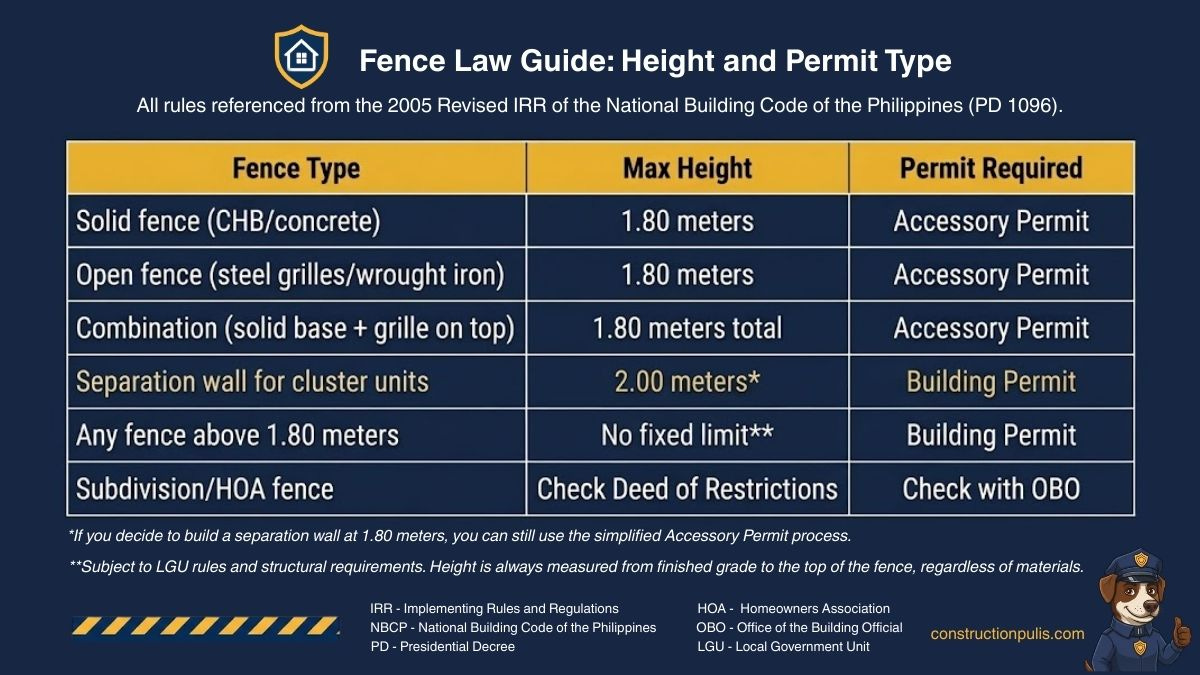
Note: The NBCP does not use the categories “solid,” “open,” or “combination.” The table above is a practical summary based on materials and height as defined in Rule 6 below.
Rule 1: The 1.80-meter rule
A standard fence is treated as a simple accessory to your home. The Accessory Permit covers fences at 1.80 meters and below, which is roughly the height of a tall door.
A fence above 1.80 meters moves into a different category entirely. Under Rule VII, Section 701, Group J, a fence over 1.80 meters is classified in the same group as water towers and swimming pools. It now requires a full Building Permit and greater structural oversight, because taller walls pose a bigger safety risk if they fall.
Accessory Permits are issued by the Building Official for activities… These permits include, among others, ground preparation and excavation, encroachment of foundation to public area, fencing, for fence not exceeding 1.80 meters high…(Rule III, Section 301, paragraph 2.b.ii)
“Group J Occupancies shall include: Division 2- Private garages, carports, fences over 1.80 meters high, tanks, swimming pools and towers.” (Rule VII Section 701 Group J)
Permit Exemptions
You do not need a building permit for the repair of a perimeter fence or wall, as long as it doesn’t violate other Code rules.
“A building permit shall not be required for the following minor constructions and repairs... Repair of perimeter fence and walls.” (Rule III, Section 301, Subsection 3.b.vi.)
Garden Walls
Small garden masonry walls (other than shared party walls) that are 1.20 meters high or less are also exempt from permit requirements.
“A building permit shall not be required for the following minor constructions... Garden masonry walls other than party walls not exceeding 1.20 meters in height...” (Rule III, Section 301, Subsection 3.a.v)
Application Requirements
When applying for a permit, you must submit a Site Development Plan that shows the exact position of the proposed fence in relation to your lot boundaries.
“Site Development Plan showing technical description, boundaries, orientation and position of proposed non-architectural horizontal structure such as: ... fences, etc. building/structure in relation to the lot...” (Rule III, Section 302, Subsection 5.a)
Rule 2: Separation walls for cluster units
Cluster units – grupo ng magkakalapit na bahay na may shared spaces
If you live in a townhouse, rowhouse, or quadruplex, the walls or fences separating your yard from your neighbor’s are allowed to go slightly higher, up to 2.00 meters. This gives closely packed homes a bit more privacy between units.
That 2.00-meter allowance, though, doesn’t change the permit rules. Anything over 1.80 meters is still classified as a Group J-2 structure, which means it requires a full Building Permit, and the separation wall must be included in your engineering plans and specifications.
If you keep the separation wall at exactly 1.80 meters, you can still use the simpler Accessory Permit process.
This rule applies to cluster housing only, not to standard single detached lots.
Accessory Permits for specialized parts (like Group J-2 structures) are for those with “very special functions or use which are indicated in the plans and specifications that accompany the building permit application“ (Rule III, Section 301, Subsection 2.b.i).
“Every court shall have a width of not less than 2.00 meters for one (1) or two (2) storey buildings. However, if the court is treated as a yard or vice versa, this may be reduced to not less than 1.50 meters in cluster living units such as quadruplexes, rowhouses and the like, with adjacent courts with an area of not less than 3.00 sq. meters.
Provided further, that the separation walls or fences, if any, shall not be higher than 2.00 meters.” (Rule VIII, Section 804, paragraph 5)
Rule 3: Corner lot fences
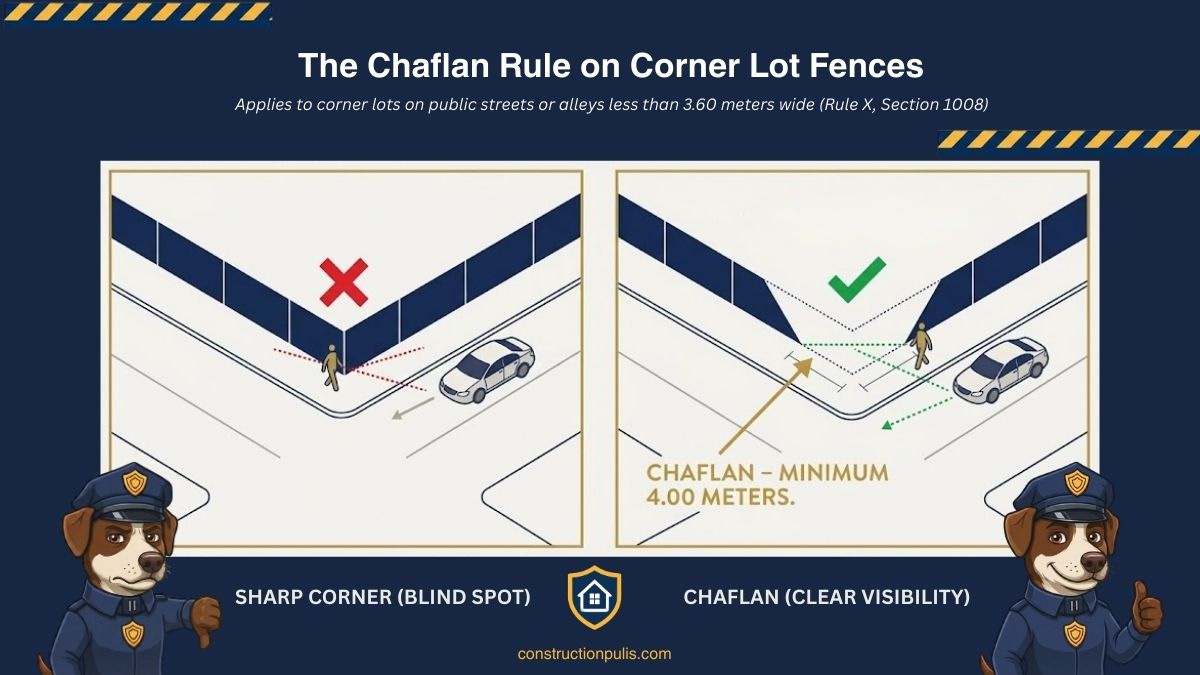
If your lot is on a corner with narrow streets, you cannot have a sharp 90-degree corner on your fence. You are required to cut the corner diagonally. This diagonal face is called a chaflan, and it must be at least 4.00 meters long.
The reason is simple: drivers turning the corner need to see oncoming traffic and pedestrians. A sharp corner blocks that view.
“Every corner building or solid fence on a public street or alley less than 3.60 meters in width shall be truncated at the corner... the length of the chaflan [shall not] be less than 4.00 meters.” (Rule X, Section 1008, paragraph 1 and paragraph 2)
Rule 4: Gate, door, and window projections
Any gate or door in your fence must swing inward toward your property. Gates that swing outward and block the public sidewalk are not allowed.
The rule is straightforward: your gate cannot project beyond your property line when it opens. This applies to doors and windows as well, not just gates.
“Doors, windows, and the like less than 2.40 meters above the pavement or groundline shall not, when fully opened or upon opening, project beyond the property line except fire exit doors.” (Rule X, Section 1007)
Rule 5: No fences on easements
If your property is beside a river, creek, or waterway, there is a strip of land called an easement, usually 3 meters wide in cities, that belongs to the public. You cannot build a fence across this area to claim it as your own. Fences are only allowed there when strictly necessary for public safety, not for private use.
“All forms of enclosures such as fences, perimeter walls and the like, intended to limit the use of the easement for private enjoyment/benefit or to restrict full access to the public easement are absolutely prohibited...” (Guidelines on Easements, Rule VIII, paragraph 3.f.)
We covered easements in more detail in What Every Homeowner Should Know About Setbacks, Easements, and Building Boundaries. Worth reading before you build.
Rule 6: Permit fees
Yes, you also pay fees based on how long your fence is and what it’s made of.
For masonry, metal, or concrete fences at 1.80 meters or below, the fee is P3.00 per lineal meter. For fences above 1.80 meters, it goes up to P4.00 per lineal meter. For light or native materials like barbed wire, chicken wire, or hog wire, the fee is P2.40 per lineal meter.
These are the base rates under the NBCP. Your LGU may charge additional local fees on top of these.
Fencing: (i) Made of masonry, metal, concrete up to 1.80 meters in height, per lineal meter... P3.00; (ii) In excess of 1.80 meters in height... P4.00; (iii) Made of indigenous materials, barbed, chicken or hog wires... P2.40.” (New Schedule of Fees, Rule III, paragraph 3.c.)
Living Fence: Option Worth Considering
Living fences are plants grown along property boundaries as natural barriers.
Before concrete and hollow blocks became the default, a lot of Filipino homes had something simpler and honestly more beautiful along their boundaries.
I remember ours. Before my family built the masonry fence, we had a dense, flowering gumamela fence lining the perimeter, and Lantana camara — those small clustered flowers in pink, yellow, and orange, bunched together in a circle, the kind Filipino kids would turn into bracelets that lasted all of five minutes. I miss those plants.

Living fences are making a comeback in the Philippines as a sustainable alternative. Besides marking boundaries, they help improve air quality, create a lush green landscape, and attract birds and butterflies.
For me, I would prefer the living fence over the concrete fence. But whichever you choose, the rules still apply.
For homeowners who haven’t broken ground yet, this is worth thinking about. Popular choices for the Philippine tropical climate include Bougainvillea for thorny security, Bamboo for dense privacy screening, Lantana camara for something colorful and low-maintenance, and, of course, the classic gumamela for something lighter and more flowering.
The practical bonus: a living fence using natural materials falls under the lightest permit fee category in the NBCP Schedule of Fees, at P2.40 per lineal meter. And if it stays low and loose, it may not require a permit at all.
For more on plant options and how to implement a living fence, this article from Pinoy Builders is a good starting point: Tropical Living Fences: Best Outdoor Plants for Natural Fences in Homes and Businesses
⚠️ As much as I’d like to promote living fence, one big factor to consider is security.
A living fence is naturally lower and more permeable than a concrete or steel fence, which may be a concern in areas where “akyat bahay” incidents are common.
If you live in a gated subdivision with security, a living fence may work well. If you’re in an area where security is a greater concern, a solid perimeter fence surrounding the entire property is still the safer choice. And you can still add plants there to maintain a green landscape.
Always safety first. Aesthetics comes second. This applies to all your house construction decisions.
Ready to Build Your Fence?
Before building anything, no matter how simple, double-check whether there are laws that cover it. Due diligence is non-negotiable.
For the specific documents and steps required to apply for a fencing permit, go directly to your local Office of the Building Official (OBO). Each LGU has its own process and requirements, and they are the most reliable source for what applies to your area.
Knowing the rules before you build is so much cheaper than finding out after.
If you are planning to fund your new fence or home renovation using a government loan, make sure you don’t repeat my mistake. Read my guide on the Pag-IBIG MPL Promissory Note: Interest Rate, Grace Period, and Advanced Payments Explained. Maybe you’re like me. I used it three times without fully understanding the promissory note.
A note on how this Dispatch is organized
The NBCP and its IRR do not present fence rules in a single section or numbered list. They are scattered across different parts of the 2005 Revised IRR — Rule III, Rule VII, Rule VIII, and Rule X. The six rules in this Dispatch are Construction Pulis’s own summary, organized in a way that’s easier for homeowners to follow. The actual IRR text is included with each rule so you can verify the source yourself. As always, rules can vary by LGU and subdivision.
Disclaimer: Kapwa Homeowner is not a licensed engineer, architect, or construction professional. The information shared on Construction Pulis is for educational purposes only and should not replace professional advice. Every construction project is unique, so always consult licensed professionals for your specific situation.